
Latent Knowledge Before Behaviour
Ongoing research. This is an experimental result from active work, not a settled conclusion. The numbers are what we measured and the method is described so you can judge it, but the programme is still running and later experiments may revise what it means.
A note on the language in these records. This is a working laboratory notebook for research into training AI models more cheaply and efficiently, so you will read that an approach did not work, that a result did not hold up, or that one method was worse than another. That is the research doing its job, not a verdict on the engineering we deliver to clients. Ruling an approach out is how the search narrows, and these are the pages that teach us the most: nearly every technique we now rely on came from understanding why something else fell short. Testing our own ideas at least as hard as anyone else's is the point of publishing them. More about this programme and why we run it.
Part of a bigger question: Can you tell in advance that a model is about to improve? – Yes, repeatedly and by several independent routes -- a probe on the hidden state, gradient statistics, held-out loss, and which earlier word the prediction leans on. The warnings are real; how far ahead they fire varies a great deal.
In plain English
What we asked. When a model suddenly gets a task right, does the knowledge appear at that moment, or was it already inside the model while it was still answering wrong?
What we found. It was already there. A small separate readout attached to the model's internals could recover the correct answer roughly 23 steps of training before the model itself could produce it. Our first attempt at this measurement said the opposite, confidently, because the readout we used was too weak to see what was present.
Why it matters. This was the first genuinely early warning signal our programme found, and it nearly did not survive its first test. The methodological point matters generally: when a measurement finds nothing, that is a statement about the measurement until you have shown the measurement can find something it should.
The rest of this page is the technical record: the design, every number, and the limits. It is written for a reviewer, and you do not need it to have understood the result above.
New here? How to read a research record
- Start at the verdict. Every record states, before the experiment was run, what result would have made us abandon the idea. That is the "kill test". Then it says whether the test fired. Nothing gets reinterpreted after the fact.
- Numbers in square brackets are uncertainty.
23.4 [18.1, 28.7]means our best estimate is 23.4 and the true value is probably somewhere in that range. If a range includes zero, we cannot claim an effect. - Results that rule an idea out are kept. Roughly half of what is published here says an approach did not work, including plenty of our own. Those pages are the output, not a shortfall: knowing which direction is a dead end is what lets the next experiment go somewhere better, and most of what we now rely on came out of understanding why something else fell short. Work that only publishes what worked is not measuring anything.
- Read the Limits section. Every record ends with what it does not show. It is the most honest part of any experiment and usually the shortest.
- Pro tip: the figures near the top are designed to carry the result on their own. If you read nothing else, read the caption under each one, which says what it shows and what to take from it.
EXPLORATORY. Not a preregistered study. Local CPU, 10 training runs, no GPU, no cost.
Program v2 tier 2, item F2. Decisive computation: analysis/decode_probe.pyanalysis/decode_probe.jsonpython analysis/decode_probe.py in about twelve minutes on a throttled laptop CPU.
The question
Every signal this program has found is coincident with the transition, or worse. The geometry peak lands at the transition under AdamW and 243 steps after it under SGD (D8). No early-trajectory metric ranks final outcomes (K1). Every controller idea in Bucket C needs something that arrives first, and nothing did.
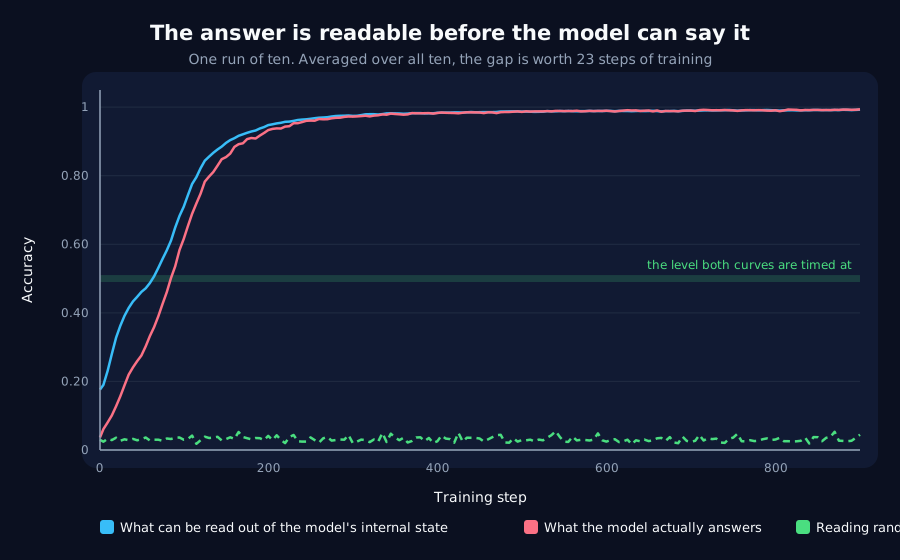
F2 looks in a different place. At each point in training, fit a linear probe from the model's hidden state to the token it is supposed to emit, and compare that probe's accuracy against the model's own.
The probe is the same function class as the output head, a linear map from final_norm to the vocabulary. So this is not asking whether some clever decoder can extract the answer. It asks whether an optimally fitted version of the readout the model already has would beat the one it has learned. If yes, the information is present and the head has not yet learned to read it.
Kill test: decodability and behavioural accuracy rise simultaneously within measurement resolution across ten seeds.
Result: the kill test fails, decisively
| Quantity | Value |
|---|---|
| Probe reaches 50% at step | 59.3 |
| Model reaches 50% at step | 82.7 |
| Lead | +23.5 steps [+22.1, +24.9] |
| Runs with a lead above the 5-step resolution | 10 / 10 |
| Largest probe-minus-model gap | +0.2071 [+0.1975, +0.2167] at step 28 |
The information is linearly present in the hidden state roughly 23 steps before the model can act on it, on a transition that lands around step 83. That is about 28% of the way to the event, and it is the first genuinely leading signal in this program.
It is not an artifact of the threshold
The 50% crossing was chosen before looking. The lead survives every level tested, and is positive in all ten runs at every one:
| Crossing level | Lead (steps) | SD |
|---|---|---|
| 20% | +24.6 | 1.9 |
| 30% | +35.6 | 3.1 |
| 40% | +39.2 | 3.8 |
| 50% | +23.5 | 1.9 |
| 60% | +14.9 | 0.7 |
| 70% | +13.4 | 0.9 |
| 80% | +13.6 | 1.7 |
| 90% | +17.5 | 3.3 |
The controls hold
- Shuffled-label control:
0.0315, against a chance level of0.0312. A probe of this capacity extracts nothing from noise, so the measured decodability is not fitting artefact. - Instrument check: the probe matches the model at the end in 10 of 10 runs (
0.9923against0.9917). This is the load-bearing control, for the reason below.
The correction that changes everything about this record
The first version of this pilot returned the opposite verdict, and it was wrong.
| First version | Corrected | |
|---|---|---|
| Lead | +1.5 steps [-0.0, +3.0] | +23.5 steps [+22.1, +24.9] |
| Runs with a resolvable lead | 1 / 10 | 10 / 10 |
| Verdict | killed | leading indicator |
Nothing about the models changed. The entire verdict flipped on probe strength, through two independent weaknesses:
- The probe was the wrong estimator. Closed-form ridge regression onto one-hot targets is a weak classifier at high accuracy. It ended training at
0.9303while the model reached0.9917: an optimally fitted readout losing to a trained one by 6 points, which is not possible if the probe is doing its job. It was replaced with a cross-entropy-fitted linear classifier, using the ridge solution as its starting point. - The probe was sample-limited. With 512 sequences it fits 1,568 parameters on 3,328 rows and under-fits badly. Raising the fitting set to ~26,000 scored positions closed the remaining gap.
Crucially, the weakness biased the answer toward the null. The under-powered probe was overtaken by the model before the 50% crossing, so its crossing was delayed by its own incapacity, and the measured lead collapsed toward zero. A weak instrument does not produce noise here; it produces a confident, wrong negative.
Standing rule adopted from this. A null result from a probe is a statement about the probe until the probe is validated against a known-achievable target. Every probe in this project must now clear an instrument check, for a readout probe, matching the trained readout at convergence , and that check must be reported alongside the result.
This is the second time in program v2 that a measurement, not a model, produced the headline: D6 found that the post-peak fall was a property of the measuring frame. Both were caught by asking what the instrument could and could not do, rather than by re-examining the data.
An observation worth carrying to F3
At step 1, before any meaningful training, the probe already reads 0.1761 against the model's 0.0368, about 5.6x chance. A substantial part of the answer is linearly present in an almost untrained recurrent state.
That is the echo-state hypothesis (F3) appearing unbidden: random recurrent dynamics already carry usable information about the lagged token, and part of what training does is learn to read what was largely already there rather than to create it. F3 should be run next, and this pilot has already given it a nonzero prior.
What this changes for the program
- The central obstacle is partially removed. Program v2's constraint table records that the transition signal is coincident, not leading. That remains true of the geometry signal. It is now false in general: a decode-probe gap leads by 23 steps.
- Bucket C's gate is half-satisfied. The gate requires D3 answering "smooth" and one of F2 / F1 / E4 producing a usable timing signal. F2 has produced one, so D3 is now the sole remaining gate and its priority rises accordingly.
- The signal is usable online. The probe needs labels, and during training the labels are in hand. Fitting it is one linear solve plus a short refinement, negligible against a training step.
- A4's non-oracle version becomes possible. The transition kick needed to act before the transition and had no way to know when that was. It now has a candidate.
Limits
- One architecture (
tiny-gru), one task, one width (48), one optimizer (AdamW). D8 showed that timing claims in this project can belong to the optimizer rather than to learning, so F2 under SGD is a required follow-up before anything is built on it. - The lead is measured between two accuracy curves crossing a level. It is not yet demonstrated that the gap predicts the transition step across seeds, with transitions spanning only ~10 steps here there is little variance to correlate against, the same limitation that made A9 unanswerable. Establishing predictive power needs the wider transition spread that a learning-rate or width sweep would give.
- 23 steps is a real lead but a short one. Whether it is enough to act on is A4's question, not this one.
Terms on this page
Every piece of vocabulary this record uses, in plain language. Generated from the text above, so it cannot drift out of step with it.
- accuracy
- The fraction of answers a model gets right on questions it was not trained on.
- AdamW
- A widely used training algorithm that adapts how big a step it takes for each individual parameter. The default in most modern AI training.
- architecture
- The blueprint of a model: what components it has and how they connect. Two models can be the same size and completely different architectures.
- cross-entropy
- The standard score a language model is trained to reduce. Lower means the model assigned more probability to what actually came next.
- GRU
- Gated Recurrent Unit. A compact design for processing sequences one item at a time, with internal switches controlling what it keeps in memory.
- hidden state
- The model's working memory: the internal numbers it carries from one step of a sequence to the next.
- kill test
- A condition written down before running the experiment that says what result would make us abandon the idea. Fixing it in advance is what stops a disappointing result being reinterpreted as an encouraging one.
- learning rate
- How big a step training takes each time it updates the model. Too small and nothing happens; too big and it never settles.
- linear probe
- A deliberately simple readout attached to a model's internals to test what information is present in them. Kept simple on purpose: if something complicated can extract the answer, the complicated thing may be doing the work itself.
- optimizer
- The algorithm that decides how to change the model given the gradient. AdamW and SGD are two common choices and they behave differently.
- parameters
- The adjustable numbers inside a model. Training is the process of setting them. Model size is usually quoted as a count of these.
- probe
- A small separate model trained to read information out of a bigger model's internals, used as a measuring instrument rather than as a product.
- rank
- How many independent directions a set of numbers really uses. A low-rank structure is one that looks high-dimensional but is actually simple underneath.
- recurrent
- A design that reads a sequence one item at a time, carrying memory forward. The main alternative is attention, which looks at everything at once.
- seed
- The number that fixes all the randomness in a training run. Same seed, same run. Running several seeds is how you tell a real effect from a lucky one.
- SGD
- Stochastic Gradient Descent. The simplest training algorithm: take a step in the direction the gradient points, every time, with no adaptation.
- variance
- How spread out a set of numbers is. Rising variance in a signal means it is becoming more erratic.
- vocabulary
- The set of distinct symbols a model can read and produce.
- width
- How many internal numbers a model uses at each layer. The usual way we vary model size in these experiments.
Get new results as we publish them
Roughly monthly, one finding per email, in plain English first. Including the approaches that turned out not to work, which are usually the useful ones. No sales email.
Double opt-in: we send a confirmation link and add nobody who does not click it. One-click unsubscribe on every email.