
The Design Carries Its Derivation
Ongoing research. This is an experimental result from active work, not a settled conclusion. The numbers are what we measured and the method is described so you can judge it, but the programme is still running and later experiments may revise what it means.
A note on the language in these records. This is a working laboratory notebook for research into training AI models more cheaply and efficiently, so you will read that an approach did not work, that a result did not hold up, or that one method was worse than another. That is the research doing its job, not a verdict on the engineering we deliver to clients. Ruling an approach out is how the search narrows, and these are the pages that teach us the most: nearly every technique we now rely on came from understanding why something else fell short. Testing our own ideas at least as hard as anyone else's is the point of publishing them. More about this programme and why we run it.
Part of a bigger question: How do we know our own results are real? – Repeatedly, the control rather than the measurement decided the result -- and several striking findings dissolved when the right comparison was finally run.
In plain English
What we asked. Experiments often set one of their settings from something measured earlier. For example, to compare a small model and a large one fairly, you might make the task harder for the large one so both take about as long to learn. That is usually the right thing to do. It becomes a trap if the experiment then asks about the very thing the setting was built from, because the answer was decided before any data came in. It had happened to us three times, and each time we found it by accident.
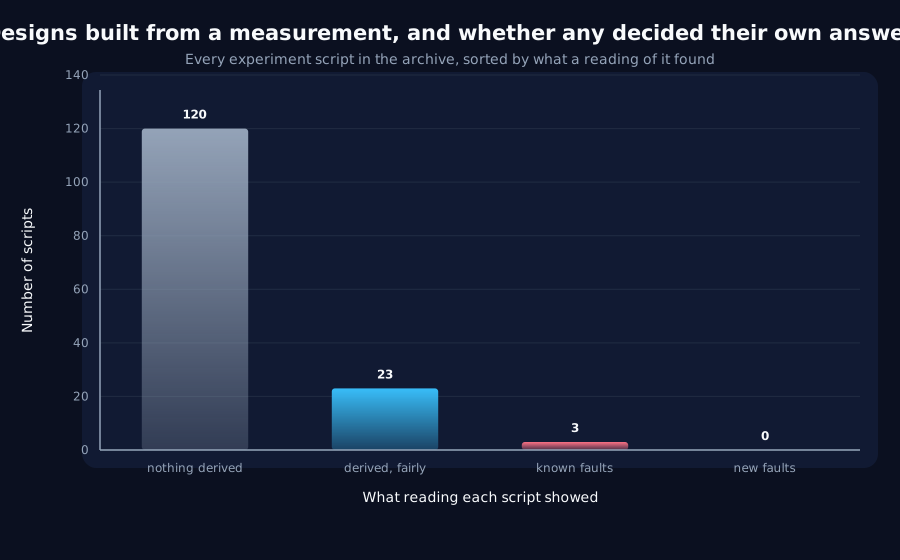
What we found. So we checked every one of our 138 experiment scripts on purpose. Twenty-six build a setting from an earlier measurement. Twenty-three of those do it fairly: to remove a confusion, to build the test openly, or to make two things comparable. The only faults are the three we already knew about. We had expected more, and said so in advance.
Why it matters. The useful part is where the three came from. Two of them were not bad designs. They were good designs, built for one question, that a later experiment reused to ask a question about the very thing they had been built from. So the rule is simple: when you borrow a setup from an earlier experiment, write down what it was tuned on, and do not use it to test that.
The rest of this page is the technical record: the design, every number, and the limits. It is written for a reviewer, and you do not need it to have understood the result above.
New here? How to read a research record
- Start at the verdict. Every record states, before the experiment was run, what result would have made us abandon the idea. That is the "kill test". Then it says whether the test fired. Nothing gets reinterpreted after the fact.
- Numbers in square brackets are uncertainty.
23.4 [18.1, 28.7]means our best estimate is 23.4 and the true value is probably somewhere in that range. If a range includes zero, we cannot claim an effect. - Results that rule an idea out are kept. Roughly half of what is published here says an approach did not work, including plenty of our own. Those pages are the output, not a shortfall: knowing which direction is a dead end is what lets the next experiment go somewhere better, and most of what we now rely on came out of understanding why something else fell short. Work that only publishes what worked is not measuring anything.
- Read the Limits section. Every record ends with what it does not show. It is the most honest part of any experiment and usually the shortest.
- Pro tip: the figures near the top are designed to carry the result on their own. If you read nothing else, read the caption under each one, which says what it shows and what to take from it.
EXPLORATORY. Not a preregistered study. No training. Reads committed pilots and records in about a second. The kill test and prior are the ones written into the program doc on 2026-09-04.
Program v2 Bucket R, item R14. Decisive computation: analysis/derived_design_audit.pyanalysis/derived_design_audit.jsonpython analysis/derived_design_audit.py.
The question
Three records here share one shape, and each was found by accident, afterwards:
- Q9 priced an instrument in a unit that cancels out of its own ratio, so the ratio could not respond to the axis under test.
- Q8 used a grid that tied width to side-of-the-transition, so every rival explanation agreed on the evidence that existed.
- R9 validated "a fixed multiple of the transition" as a predictor on a donor ladder that had been built by scaling by that same quantity, so the predictor and a duller rival landed
0.037of a rung apart and the test could not fail.
In all three the design decided what could be concluded. This looks for the rest deliberately, with the mechanical form of the question: does any design parameter get its value from a quantity the record -- or a later record reusing the design -- then tests, measures, predicts or prices?
Kill test, fixed before execution: fewer than 5% of records have a design parameter derived from the quantity under test, in which case the known cases are a coincidence rather than a pattern.
Prior recorded in advance: good that it is well above 5%. Scaling one arm to match another is the most natural way to make a comparison fair, and it is exactly what creates the problem.
Design
Three scans decide what gets read; the reading decides the verdict. The same shape as R15, which audited a different fault the same way.
- Derivation comments -- a documented constant whose comment says it was calibrated, scaled, matched or taken from a measurement.
- Imported designs -- a ladder, grid or rung set imported from another pilot, carrying its calibration into a record that may ask a different question of it.
- Event-calibrated constants -- a learning rate, window or budget chosen so that the transition lands somewhere, in a pilot whose record measures timing relative to it.
Every flagged pilot is then read and classified in the script, with a one-line reason, as KNOWN (one of the three cases above), CONFIRMED (a new case) or DIFFERENT (derived from a measurement, but the conclusion could have gone either way). The script refuses to decide the kill test while any flagged pilot is unread, and it did refuse, once, on its first run: four candidates the scans found and the author had not anticipated.
Result: the kill test fires
| Pilots | |
|---|---|
| scanned | 138 |
| flagged by at least one scan | 26 |
KNOWN | 3 |
CONFIRMED (new) | 0 |
DIFFERENT | 23 |
Three records of 151 -- 2.0%, against a 5% threshold -- and they are the three that prompted the audit. The recorded prior was wrong, for the second time in two audits of this kind.
Where the derived designs went instead
The twenty-three DIFFERENT cases fall into four groups, and none of them lets the design choose the answer:
| What the derivation does | Examples | Why it cannot decide the answer |
|---|---|---|
| Removes a confound | P11's matched ladder and its six descendants (P12's four cases, Q1, Q5, Q13) | the ladder fixes the control's transition time; no record then asks whether anything depends on it |
| Builds the test deliberately | N6's equal-requirement pairs; the weight-spectrum rates spread to move the transition | the tested quantity is varied or matched openly, and N6's collapse failed |
| Reserves room for an instrument | the early-warning detectors (F1, A11, G1, G6, K1's matched rung) | room makes a lead possible, not positive -- an alarm can still fire late -- and F1 carries a random-time-matched null; A11's horizon was later tested by K1 |
| Matches for comparability | run lengths (N5's lesson), parameter counts, reused configurations | matching, not deriving an answer |
The richest group is the first: eight records use one calibration principle -- set the task's difficulty so the control's transition time stays roughly constant -- three of them by importing P11's or P12's ladder directly and the rest by calibrating their own rung the same way. In every one it does the job it was built for. That is the finding worth keeping, because it is the opposite of what the prior expected.
Where the fault actually entered
Read back through the three known cases with this table beside them, and two of the three are reuse, not derivation:
- R9: R5 scaled P8's ladder by the transition ratio to make rungs comparable across tasks -- a legitimate derivation, classified
DIFFERENThere. The fault entered a day later, when R9 reused that ladder to test the transition ratio as a predictor. The design was fine for the question it was built for and fatal for the next one. - Q9: J7's scored-rows unit was a natural bookkeeping choice for J7. It became a fault when a width comparison was priced in it.
- Q8 alone was a fresh design that tied two explanations together from the start.
This is the same conclusion R15 reached for a different fault: the risk is concentrated where a design built for one question is reused for another, or where a record leaves a house convention on purpose. A derived design carries its derivation with it -- import a calibrated ladder, and every quantity it was calibrated on becomes something that ladder cannot test.
What stands
- The kill test fires.
3of151records, all three already known; zero new cases among23other derived designs, each read and classified in code. - The prior was wrong, and why is the finding: derived designs here are overwhelmingly used to remove confounds, and do that job.
- The fault entered at reuse. Two of three known cases are a design built for one question and reused for a question about the very quantity it was derived from.
- The practical rule, for this archive and any other: when you import a ladder, grid or unit, write down what it was calibrated on, and do not use it to test that.
Limits
- Two of the three known fault types are not constant derivations. Q9's cancelling unit and Q8's tied grid cannot be found by scanning constants; they were counted here as known cases, not detected. A tied-grid audit is mechanically possible -- for every record varying two or more factors, measure how well each factor predicts the others across its cells -- and that is R16.
- The scans find documented derivations. A constant derived from a measurement with no comment saying so is invisible to scan 1; scans 2 and 3 cover the two forms that matter most here, but an undocumented derivation in a pilot that neither imports a design nor mentions the transition would be missed.
- "Could have gone either way" is a judgement for each
DIFFERENTcase, and each one's reason is in the script so a reader can disagree with a specific line rather than with the total.
Terms on this page
Every piece of vocabulary this record uses, in plain language. Generated from the text above, so it cannot drift out of step with it.
- calibrated
- A model is calibrated when its confidence matches how often it is right: answers it gives with 90% confidence should be right about 90% of the time.
- calibration
- Working out an instrument's settings from runs whose answer you already know, so it can be used on a run whose answer you do not.
- confound
- A second explanation you did not control for. If bigger models both learn faster and score higher, then 'fast learners score higher' may be entirely about size and not about speed.
- kill test
- A condition written down before running the experiment that says what result would make us abandon the idea. Fixing it in advance is what stops a disappointing result being reinterpreted as an encouraging one.
- learning rate
- How big a step training takes each time it updates the model. Too small and nothing happens; too big and it never settles.
- width
- How many internal numbers a model uses at each layer. The usual way we vary model size in these experiments.
Get new results as we publish them
Roughly monthly, one finding per email, in plain English first. Including the approaches that turned out not to work, which are usually the useful ones. No sales email.
Double opt-in: we send a confirmation link and add nobody who does not click it. One-click unsubscribe on every email.